
Article: Infrared Sauna with Red Light Therapy: Is It Worth the Upgrade?
Infrared Sauna with Red Light Therapy: Is It Worth the Upgrade?
Open the control panel of a lot of "red light" saunas and something underwhelming happens: a dim red glow flickers on — a cosmetic LED, roughly as therapeutic as the light inside your toaster. It looks the part in the product photos, and it's enough to justify printing "RED LIGHT THERAPY" in the title. But it is not the same thing as a real, wavelength-specific treatment.
This guide is about telling those two things apart — and deciding whether the genuine version is worth paying for when it's built into an infrared sauna. The short answer is yes, with a caveat we'll get to: only if it's the real thing, and only if the sauna is already good at heating you.
Here's everything you need to know to avoid paying a premium for a colored light bulb.
At a Glance
|
Question |
Short answer |
|
What is red light therapy? |
Specific wavelengths of light (660nm red, 850nm near-infrared) that stimulate your cells |
|
Is it the same as infrared? |
No — red light treats the skin's surface; infrared is invisible light that heats you |
|
Why put both in a sauna? |
They complement each other: heat warms you, light works on your cells |
|
Is it worth the upgrade? |
Yes — if it's real (660/850nm), not a cosmetic 4-watt LED |
|
The catch |
Most "red light" saunas under $2,000 use a decorative light, not a therapy device |

Red Light Therapy, Explained Without the Hype
Red light therapy (also called photobiomodulation, or PBM) is the use of specific wavelengths of red and near-infrared light to trigger biological changes in your cells. It's not new — light has been used as medicine for over a century, and Niels Finsen won the 1903 Nobel Prize in Medicine for pioneering phototherapy. What's newer is the explosion of affordable home devices — and, predictably, the flood of cheap imitators.
The mechanism, in one sentence: certain wavelengths of light are absorbed by the mitochondria — the energy engines inside your cells — and nudge them to produce energy more efficiently and reduce inflammation. That's the "photo" + "bio" + "modulation": light changing biology.
Two things matter enormously, and they're exactly what cheap products get wrong:
- The wavelength has to be right. Not every red light is therapeutic. The two most-studied windows are 660 nm (visible red) and 850 nm (near-infrared).
- The intensity and distance have to be right. Light is only useful if enough of it reaches your skin, at close enough range. A dim bulb across the room does nothing.

Red Light (660nm) vs. Near-Infrared (850nm): Two Wavelengths, Two Jobs
Here's the distinction that separates a real therapy device from a red-tinted bulb:
|
Wavelength |
What it is |
Where it works |
What it does |
|
660nm (red) |
Visible red light |
The skin's surface |
Supports collagen, skin tone, circulation |
|
850nm (near-infrared) |
Invisible light |
Deeper — into muscle and tissue |
Supports recovery, reduces inflammation |
They're often bundled together because they do different jobs at different depths. Red light stays at the surface — which is why it's linked to skin and collagen benefits. Near-infrared penetrates further — which is why it's linked to muscle recovery and deeper tissue. A genuine "full" red light setup gives you both. A cosmetic one gives you neither, in any meaningful dose.

Red Light Therapy Is NOT the Same as an Infrared Sauna
This is the most common confusion, and it's worth clearing up before anything else:
- An infrared sauna heats your body using invisible infrared light (mostly far-infrared in a classic cabin). Its job is thermal — raising your core temperature so you sweat, your heart rate climbs, and heat-shock proteins activate.
- Red light therapy doesn't heat you. Its job is photochemical — light interacting directly with your cells, independent of temperature.
So they're two completely different tools that happen to both use "light." The reason they're a natural pair is that they don't overlap — they stack:
The sauna works on your heat response. The red light works on your cells. Together, you get the systemic benefits of heat therapy plus the targeted, heat-independent benefits of light therapy in one session.
That's the whole case for combining them — and the whole reason a brand like YardSauna builds the red light into the sauna rather than selling it as a separate gadget.
The Honest Problem: Most "Red Light" Saunas Don't Have Real Red Light
Here's where it gets uncomfortable, and where you can actually save yourself from overpaying.
Independent reviewers who've torn down dozens of saunas keep finding the same thing: in the budget tier, the "red light therapy" is a strip of decorative LEDs — often just a few watts, sometimes nothing more than a color option on the interior light. It's there to let the listing say "red light therapy" without actually delivering the wavelengths, intensity, or placement that would make it therapeutic.
The tell-tale signs:
- No wavelength is specified. Real red light therapy names its wavelengths — 660nm, 850nm. "Red light" with no number is a color, not a treatment.
- It's a single small strip mounted somewhere you'll never actually be close to. Light therapy needs proximity — roughly a foot or less from your skin.
- It looks like a color-changing LED in the corner, not a panel facing your body.
The rule is the same one we apply to EMF in the last guide: if a feature isn't quantified, assume it's marketing. "Red light therapy" with no wavelength is the red-light equivalent of "low EMF" with no number.

What the Science Actually Supports (Graded Honestly)
We apply the same honesty rule here as everywhere else. Red light therapy is promising and genuinely studied — but the evidence is not equal across every claim.
|
Benefit |
Evidence level |
Honest note |
|
Skin — collagen, tone, wrinkles |
Moderate–strong |
The most-studied area; many human trials on skin rejuvenation |
|
Muscle recovery & soreness |
Moderate |
Real studies, often small; mixed results across protocols |
|
Joint & localized pain |
Moderate |
Supportive for certain conditions; not a cure |
|
Wound healing |
Emerging–moderate |
Promising, much of it preclinical |
|
Hair growth |
Moderate |
Some strong trials for specific devices |
|
"Detox" / weight loss |
Weak/oversold |
Not a meaningful mechanism; ignore these claims |
The takeaway: red light therapy is a legitimate, targeted add-on with real — if not miraculous — benefits. It is not a replacement for the sauna's heat, and it is not the reason to buy a sauna. It's the reason to choose one sauna over another, once you've already decided on the heat.
Is It Worth the Upgrade? The Actual Math
If you're trying to decide between a plain infrared sauna and one with red light built in, here's the honest arithmetic.
Standalone red light therapy isn't cheap. A serious home panel from a reputable brand runs roughly $300 to $1,500+, and the high-end full-body devices go well above that. So when a sauna bundles real 660/850nm light into the cabin, you're effectively getting a light-therapy device and a sauna in one footprint, one outlet, and one purchase.
The real question isn't "does red light cost extra" — it's "am I paying for real wavelengths, or for a colored bulb?" Because:
- A sauna with genuine 660nm + 850nm light is worth more — you're skipping a separate
300–1,500 device.
- A sauna with a decorative red LED is worth nothing extra — you're paying for a photo.
So the "is it worth it" decision collapses into a single, checkable question: does it name its wavelengths, and are the emitters actually positioned where they'll hit your body? If yes, it's a real upgrade. If no, don't pay for it.

Where the YardSauna Forest Series Lands
The Forest series puts this to the test the honest way: it specifies the wavelengths, because that's the only way the claim means anything.
- The red light therapy is 660nm red + 850nm near-infrared — the two most-studied wavelengths, bundled so you get both the skin-surface and deeper-tissue effects.
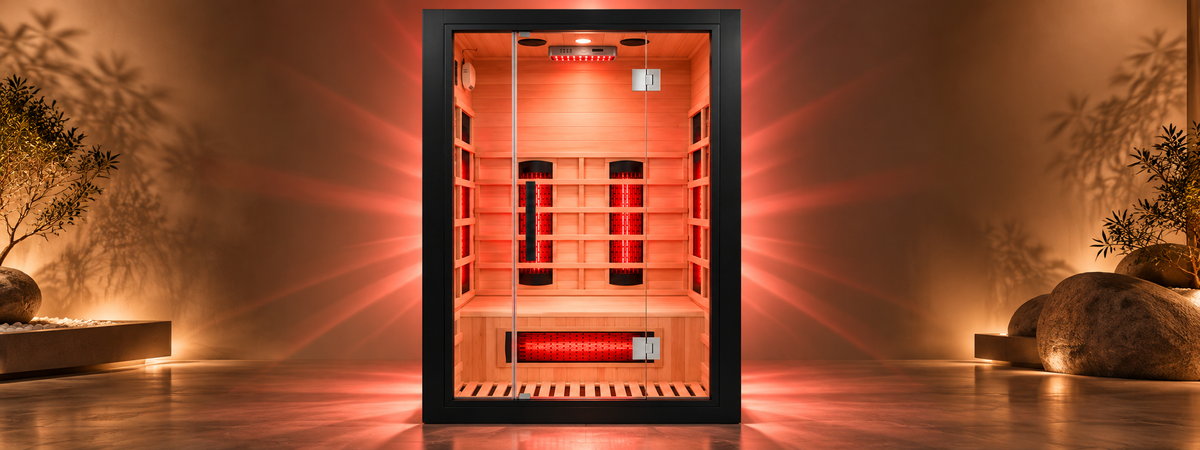
- It's integrated into a sauna that's already built around a hybrid heating system (full-spectrum quartz for fast warm-up + ultra-low-EMF carbon panels for deep, even far-infrared heat). The point: the light is an addition to a sauna that already does its primary job well — not a gimmick bolted onto a weak heater.
- The sauna itself is the same honest spec we've covered elsewhere: Grade-A Canadian Hemlock, certified Ultra-Low EMF carbon heating, and three sizes (1/2/3-person) to match your space.
The logic to remember: a red light upgrade is only worth it on top of a sauna that already heats you properly. The Forest series earns the light because it doesn't need the light to justify itself.
Five Mistakes People Make About Red Light Therapy in a Sauna
1. Buying "red light therapy" with no wavelength. If the brand can't tell you 660nm or 850nm, it's a colored bulb. That's the whole test.
2. Confusing red light with the sauna's infrared heat. One is photochemical (light → cells), the other is thermal (light → heat). They're complementary, not interchangeable.
3. Assuming more is better. Light therapy has a dose window — too little does nothing, but blasting yourself longer doesn't linearly add benefit. Follow the guidance, don't sit under the light for an hour thinking it doubles.
4. Expecting the light to do the sauna's job. Red light won't make you sweat or raise your core temperature. If you buy a weak heater with a "red light" sticker, you've bought a weak heater with a light.
5. Paying a premium for a bulb. The upgrade is only worth it if it's real wavelengths at real intensity. Otherwise you're paying for a photo op.
Quick Glossary
|
Term |
What it means |
|
Red light therapy / PBM |
Photobiomodulation — light stimulating cells, independent of heat |
|
660nm |
Visible red light; works on the skin's surface (collagen, tone) |
|
850nm |
Near-infrared light; penetrates deeper into muscle and tissue |
|
Wavelength |
The "color" of light, measured in nanometers (nm); determines what it does |
|
Mitochondria |
The energy engines in your cells that red/NIR light activates |
|
Far-infrared |
The invisible light that heats your body in a classic infrared sauna |
Frequently Asked Questions
Is red light therapy the same as infrared? No. Red light therapy is visible/near-infrared light that stimulates your cells without heating you. An infrared sauna uses invisible infrared light to heat your body. They're two different tools that can be combined in one cabin.
What do 660nm and 850nm do differently? 660nm red light stays at the skin's surface and is most associated with collagen and skin tone. 850nm near-infrared penetrates deeper into muscle and tissue, where it's linked to recovery and reduced inflammation. A good setup gives you both.
Does red light therapy in a sauna actually work? Real red light therapy (correct wavelength, intensity, and distance) has genuine — if modest — evidence behind it, especially for skin. What often doesn't work is the decorative LED strips on budget saunas, which aren't delivering therapeutic wavelengths or intensity.
How do I know if a sauna's red light is real? Ask for the wavelengths (should be specific, like 660nm and 850nm) and where the emitters are placed. If there's no number, or it's a single small strip far from your body, it's decorative — don't pay extra for it.
Is red light therapy in a sauna worth the extra cost? Yes, if it's real. A standalone red light device costs 300–1,500+, so genuine built-in light can be a real value. It's only not worth it when it's a cosmetic bulb dressed up as a feature.
Can I use the sauna without the red light on? Yes. In most integrated designs the red light is independent of the heater, so you can run the sauna alone, the light alone, or both together.
How close do I need to be to the light? Light therapy drops off quickly with distance. For meaningful exposure you want the emitters within roughly a foot of your skin — which is why placement matters more than a single bulb in the corner.
Does red light therapy help with skin aging? This is the best-supported area, with multiple human trials showing improvements in skin tone, texture, and fine lines from regular use. It's the strongest, most honest reason to value the feature.
Is near-infrared light safe? Yes. Red and near-infrared light are non-ionizing — completely different from UV or X-rays. They don't damage DNA. Standard practice is just to avoid staring directly at bright panels.
Will red light therapy make me sweat or detox? No. Red light doesn't heat you, so it won't cause sweating — and the "detox" framing is marketing, not mechanism. The sauna's heat does the sweating; the light does the cellular work. They're separate.
The Bottom Line
Red light therapy in an infrared sauna is a genuinely useful upgrade — when it's real. The entire decision comes down to one question you can ask any brand in ten seconds:
"What wavelengths, and where are the emitters?"
If they answer "660 and 850 nanometers, positioned to face your body" — like the YardSauna Forest series — you're getting a legitimate two-in-one: a proper sauna and a light-therapy device. If they mumble about "our special red glow," you're looking at a bulb.
The sauna's heat is the reason to buy. The light is the reason to choose this sauna over the next one.
More from YardSauna
Browse every guide and update at our resource hub: yardsauna.net
This article is for educational purposes only and is not medical advice. Red light therapy evidence is evolving and varies by device, wavelength, and protocol; the statements above reflect the current consensus and should not be read as guarantees of specific outcomes. Consult a qualified professional before beginning any new wellness routine.