
Infrared Sauna vs Traditional Sauna: Which Is Right for You?
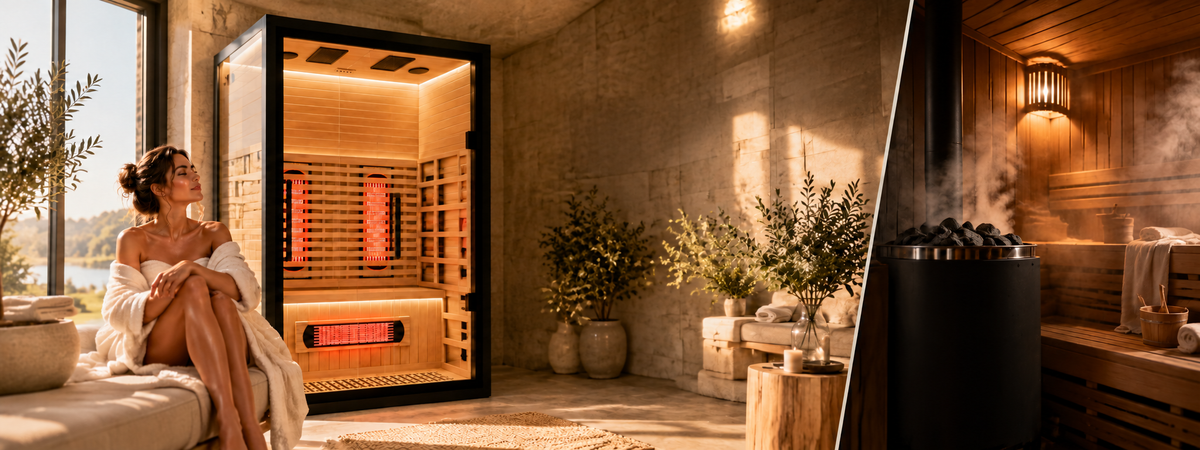
If I had to compress this whole comparison into a single sentence, it would be this: a traditional sauna heats the room until you sweat; an infrared sauna heats your body until you sweat.
They both end in sweat, which is why so many reviews treat them as interchangeable. They aren't. The difference is mechanical, and it cascades into everything else — how hot it feels, how fast it's ready, what it costs to run, which one has the stronger research behind it, and most importantly, which one you'll actually use three times a week for the next decade.
This guide breaks down the two types across six dimensions, says plainly where the evidence lands (including the parts that favor the other side), and gives you a decision framework so you don't end up with an expensive box you never open.
Here's the short version, before we go deep:
|
|
Traditional Sauna |
Infrared Sauna |
|
Best if you want |
The löyly ritual, intense heat |
Daily recovery, gentle deep heat |
|
Temperature |
150–195°F |
110–150°F |
|
Ready in |
30–60+ minutes |
15–30 minutes |
|
Typical session |
10–15 minutes |
30–45 minutes |
|
Cost per session |
Higher (long preheat) |
~$0.20 |
|
Typical placement |
Often outdoor (barrel) |
Usually indoor |
|
Research base |
Decades (longevity) |
Younger (recovery, pain) |

How They Actually Work: The Mechanical Difference
A traditional Finnish sauna uses a heater — electric or wood-burning — loaded with stones. The heater warms the air to 150–195°F, and that hot air slowly heats your body from the outside in. Throw water on the stones and you get löyly, the burst of steam that defines the Finnish sauna ritual.
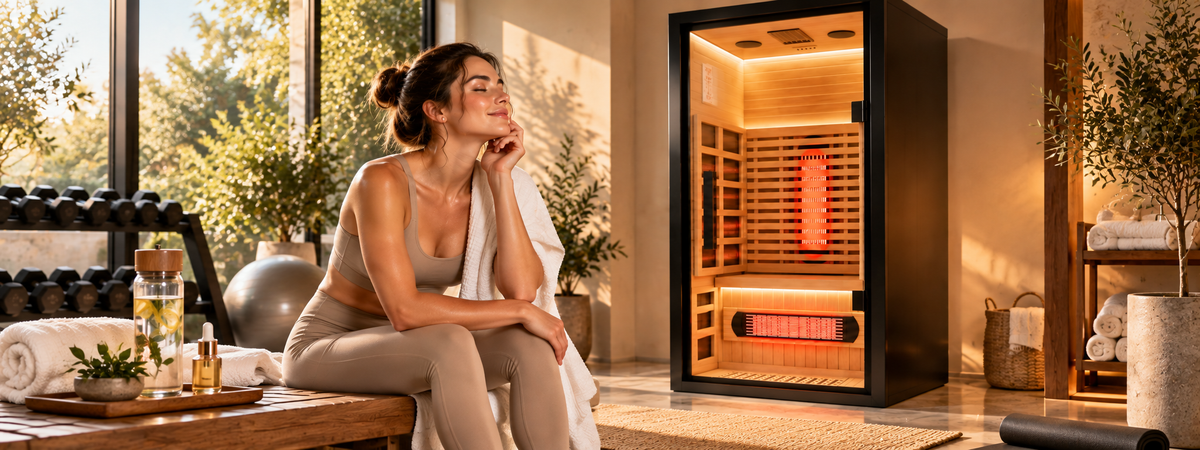
An infrared sauna skips the hot air entirely. It uses light — specifically far-infrared wavelength — to heat your body directly, while the surrounding air stays a much cooler 110–150°F. There's no löyly, no steam, and the wood walls never get scorching hot.
Here's the same thing as a table:
|
|
Traditional Sauna |
Infrared Sauna |
|
What it heats |
The air, then you |
Your body, directly |
|
Typical temperature |
150–195°F |
110–150°F |
|
Humidity |
Low, spikes with löyly |
Dry |
|
Time to heat up |
30–60+ minutes |
15–30 minutes |
|
Feels |
Intense, humid, enveloping |
Gentle, deep, dry |
|
The ritual |
Löyly, social, Finnish tradition |
Quiet, solo, daily recovery |
That "time to heat up" row matters more than people realize. A traditional sauna asks you to plan 45 minutes ahead; an infrared sauna is ready in the time it takes to change clothes. That single difference shapes how often each one actually gets used.

Temperature, Time, and Feel: What the Numbers Really Mean
The temperature gap — 150–195°F versus 110–150°F — is the first thing everyone notices, and the first thing everyone misinterprets. Let's clear up two common confusions.
Lower air temperature does not mean "weaker." Because infrared heats you directly, your core body temperature can rise just as much as it does in a traditional sauna, even though the air feels 50°F cooler. You can sweat as much or more in an infrared session, precisely because the comfortable air lets you stay in longer. This is the key to understanding why infrared is a legitimate heat-therapy tool, not a "soft" version of the real thing.
But — and this is the honest part — the long-term health data does not transfer one-to-one. The most impressive sauna research — the Finnish studies showing lower cardiovascular mortality and dementia risk — was conducted on traditional saunas running at 176–212°F. Infrared saunas have not been studied over decades the same way. The Mayo Clinic's current guidance, updated in 2024, describes infrared-specific benefits as promising but preliminary. More on this below.
So the fair framing is: infrared produces the same acute physiological response (elevated heart rate, deep sweat, heat shock proteins) at a more tolerable temperature, but the long-term evidence base is younger and thinner than the traditional sauna's. Sauna researcher Dr. Rhonda Patrick puts it plainly: infrared doesn't deliver the full effect of a hot traditional sauna unless you stay in it considerably longer — often about twice as long.
Two more practical numbers worth knowing before we move on:
Session length runs in opposite directions. A traditional session often lasts just 10–15 minutes, because the heat is too intense to stay much longer. An infrared session comfortably runs 30–45 minutes. That longer window matters — because the tolerable air lets you sweat longer, total sweat output in an infrared session can match or even exceed a traditional one.
The humidity difference changes the experience. Traditional saunas are dry until a ladle of water on the stones spikes the humidity, which is part of the ritual; steam-sauna variants stay humid throughout, and some people find that soothing for congested airways. Infrared is dry heat — easier on breathing for many, but it won't give you that steam-room effect.

The Health Benefits: Where the Evidence Actually Lands
This is where we have to be straight, including the part that doesn't flatter the product we sell.
What traditional saunas have: decades of data
The landmark KIHD study, published in JAMA Internal Medicine, followed 2,315 Finnish men for over 20 years. Men who used a sauna 4–7 times a week had roughly 50% lower risk of fatal cardiovascular disease and 40% lower risk of dying from any cause, compared to once-a-week users. Follow-up work found the same pattern in women, and the same cohort linked frequent sauna use to a 66% lower risk of dementia and 65% lower risk of Alzheimer's.
That's a genuinely strong, dose-dependent signal. It's also important to note it shows association, not proven causation — and it's specifically about traditional saunas.
What infrared has: promising, younger evidence
Infrared's research is smaller and shorter, but it points in a consistent direction:
- Recovery and muscle soreness: Repeated infrared heat expands blood plasma volume and triggers heat shock proteins that ease delayed-onset muscle soreness (DOMS) after exercise — one of the better-supported infrared findings.
- Pain and joint relief: Pilot studies (including a 2009 Clinical Rheumatology trial) found people with rheumatoid arthritis and ankylosing spondylitis reported less pain and stiffness during and after infrared sessions.
- Blood pressure: Far-infrared trials show systolic reductions of roughly 5–10 mmHg after 4–12 weeks of consistent use.
- Circulation and endothelial function: Japanese "Waon therapy" studies (far-infrared at ~140°F) documented improved blood vessel flexibility, even in chronic heart failure patients.
Where they meet
Here's the bridge between the two: the mechanism is shared. Both raise your core temperature, elevate your heart rate to 100–150 bpm, trigger deep sweating, and activate heat shock proteins. That's why many researchers believe infrared will eventually show similar cardiovascular benefits — the physiology is there — but the decades-long cohort data simply hasn't been collected yet.
The honest bottom line: if your primary goal is the best-documented longevity data, a traditional sauna is where the research is strongest. If your goal is daily recovery, pain relief, and a heat habit you can actually sustain — infrared's tolerability and fast heat-up are genuine advantages, and the evidence, while younger, is real.

Traditional Finnish saunas have been studied for decades because of their cultural history in Scandinavia. While infrared technology is newer, recent medical research shows it achieves similar core physiological benefits (deep sweating, increased heart rate, thermal shock response) at much lower, more comfortable temperatures
Cost: Upfront, Ongoing, and Hidden
Price is where a lot of buyers lose money, because they compare sticker prices while ignoring what happens after purchase. Here's the full picture, using figures verified in September 2026.
|
Type / Model |
Upfront price |
Heat-up |
Est. cost/session |
Worth knowing |
|
Portable tent / blanket (Amazon, eBay) |
|
~10 min |
~$0.10 |
Head outside the heat; "detox" marketing hype |
|
Amazon white-label 2-person (OUTEXER & more) |
~ |
20–30 min |
~$0.20 |
Self-reported EMF; thin wood; short warranty |
|
Infrared — Dynamic Andora (2-person) |
~$2,299 |
~20 min |
~$0.20 |
EMF self-reported; 5-yr warranty; mid-grade wood |
|
Infrared — YardSauna Forest (2-person) |
$4,288 |
15–30 min |
~$0.20 |
Certified Ultra-Low EMF + Grade-A Hemlock as standard |
|
Infrared — Sunlighten Signature II |
$5,599 |
15–30 min |
~$0.20 |
No red light at this tier |
|
Infrared — Clearlight Sanctuary 2 |
$7,399+ |
15–30 min |
~$0.20 |
Highest cost; red light sold separately |
|
Traditional — Almost Heaven Logan (1-person) |
$4,172 |
30–60 min |
higher |
Needs heat tolerance; high-power circuit |
|
Traditional — family-size (typical) |
|
30–60 min |
higher |
Larger footprint; longer heat-up |
Notice where the Forest series lands: it's priced in the quality middle — above the self-reported-EMF budget tier, below the $5,600+ premium tier — while including the certified Ultra-Low EMF heaters and Grade-A Hemlock that are the reason the top tier costs more.
Three things worth saying plainly:
-
First, infrared wins on running cost. A typical infrared unit draws 1,600–2,400W and heats up in minutes, so a 45-minute session costs roughly
0.16–0.23. A traditional electric heater runs at 4.5–9kW and must preheat the whole room for 30–60 minutes — meaningfully more energy per session, every session, for years. - Second, the traditional sauna's cost is also a time cost. A 45-minute preheat before every use is a real barrier. Plenty of traditional sauna owners are honest that they use theirs less often than they planned, simply because of the lead time.
- Third, "cheap infrared" has its own hidden costs. The sub-$2,000 infrared units are cheaper upfront, but they typically have self-reported (unverified) EMF figures, shorter warranties, and mid-grade wood that warps faster. When comparing, standardize on heat delivery, EMF documentation, and wood grade — not just the sticker.
-
And at the very bottom, the portable tents and blankets (
150–600) are a different product entirely. Your head stays outside the heat, so a good portion of your body never absorbs infrared at all. They're a fine, low-commitment way to try heat therapy — but they're not a substitute for a real cabin.
The Third Option: Hybrid Saunas
Before you commit to one or the other, it's worth knowing a third category exists: hybrid saunas, which pair a traditional heater with infrared panels in a single unit. They let you run the classic high-heat, steamy session when you want the löyly ritual, and switch to low-heat infrared when you want a quick recovery session — at a higher price and a larger footprint than either type alone.
Hybrids are a legitimate choice if you genuinely want both experiences and have the budget and space. For most people, though, they're overkill — it's usually cheaper and simpler to pick the one experience you'll use most often. If you're genuinely torn between the two, a hybrid resolves the debate; if you already lean clearly one way, save the money
Who Each One Is Actually For
By now the pattern should be clear. Here's the honest breakdown:
Choose a traditional sauna if you:
- Love intense, high-temperature heat and the steam of löyly
- Want the Finnish ritual and social experience
- Don't mind a 30–60 minute preheat
- Prioritize the longest-running longevity research
- Have the space and a high-power electrical circuit
Choose an infrared sauna if you:
- Find 180°F+ air uncomfortable or hard to breathe
- Want a daily recovery tool that's ready in minutes
- Prefer a gentle, deep heat you can stay in longer
- Have limited space or a standard electrical setup
- Want verified low EMF and controllable heat delivery
- Want the option to add red light therapy (a pairing traditional saunas don't offer)
Neither is objectively "better." They're different tools for different people — and a surprising number of buyers pick the wrong one because they only look at the temperature number and assume higher = more effective.
Placement is the quiet tiebreaker. Traditional saunas — especially wood-burning barrel models — are the classic outdoor or backyard choice, and what most people picture for a garden retreat. Infrared saunas are almost always indoor units, built for a spare room, basement, or home gym. If your vision is a backyard barrel sauna under the stars, that points traditional; if it's a corner of your home gym, that points infrared.

How to Choose: Three Questions That Settle It
Forget the spec sheets for a minute. Answer these three, and the decision makes itself:
- Can you comfortably sit in 180°F+ air? If the thought is unpleasant, traditional saunas will feel like an ordeal — and an ordeal you won't repeat. Go infrared.
- Do you want a ritual or a daily tool? Traditional saunas are an event — the löyly, the steam, the slow warm-up. Infrared is a utility — heat on, in, recover, out. Most people who want daily use end up with infrared, because the friction is lower.
- How much do you value the longevity data vs. tolerability? If you want the most heavily researched option and can handle the heat, traditional is defensible. If you want a sustainable habit you'll actually keep, infrared's lower barrier wins.
A useful mental model: traditional saunas are like a weekly spa visit; infrared saunas are like a daily workout. Both are good for you. You're more likely to do one of them every day.

Five Mistakes People Make Choosing Between Them
Mistake #1: Assuming "lower temperature = fewer benefits"
The most common error, and the reason many people dismiss infrared before trying it. The benefit comes from your core temperature rising, not the air temperature — and the screen readout doesn't even measure that. As independent reviewer Matt Justice (who has tested 40+ saunas) puts it: a sauna with properly positioned heaters produces a better sweat at a lower air temperature than a hotter sauna with poor heater coverage. Judge by sweat and how your body responds, not by the number on the thermostat.
Mistake #2: Borrowing the traditional sauna's longevity data for infrared
It's tempting to cite the "50% lower cardiovascular mortality" number and assume any sauna delivers it. That data is from traditional saunas. Infrared's evidence is promising but younger. Claim it honestly, and it builds trust; overclaim it, and you'll be corrected.
Mistake #3: Comparing sticker price while ignoring preheat and running cost
A traditional sauna's real cost includes 30–60 minutes of preheat energy before every session, for years. An infrared unit costs pennies per session and is ready in minutes. Over a decade, the "cheaper" sticker can be the more expensive habit — either in energy or in the fact that you stop using it.
Mistake #4: Ignoring the electrical requirement
Traditional electric heaters run at 4.5–9kW and need a dedicated high-power circuit; most infrared units plug into a standard 120V/20A dedicated circuit. Confirm your panel before you buy, not after the crate arrives — a surprise electrical upgrade can add hundreds.
Mistake #5: Forgetting EMF, the infrared-specific variable
Traditional saunas don't have this consideration; infrared ones do, because they run on electric heating elements. One thing worth knowing: "EMF" isn't a single measurement — it covers magnetic fields, electric fields, and radio frequency, and a sauna can look clean on one while still measuring high on another. That's why the useful test is whether a brand publishes specific, third-party-verified figures — not just the words "low EMF" with no numbers.
Frequently Asked Questions
What's the main difference between an infrared and a traditional sauna?
A traditional sauna heats the air (150–195°F), which then heats you; an infrared sauna heats your body directly with light, while the air stays cooler (110–150°F). Infrared is more tolerable, heats up faster, and runs dry; traditional offers the high-heat, steamy löyly experience.
Is an infrared sauna as effective as a traditional sauna?
For the acute response — elevated heart rate, deep sweat, heat shock proteins — yes, infrared produces the same physiology at a lower temperature. For long-term outcomes, traditional saunas have far more decades-long research; infrared's evidence is promising but younger, and the Mayo Clinic describes it as preliminary.
Which is better for muscle recovery?
Infrared has the stronger, more specific evidence for post-exercise recovery and muscle soreness, largely because its lower temperature and faster heat-up make it practical to use right after a workout.
Which is better for weight loss?
Honestly, neither is a weight-loss tool. Both cause temporary water loss through sweat, which returns when you rehydrate. The real benefits are cardiovascular, recovery, and stress — not fat burning.
How hot does each sauna get?
Traditional saunas run 150–195°F (Finnish studies used up to 212°F); infrared runs 110–150°F. Because infrared heats you directly, it can raise your core temperature just as much at the lower air temperature.
Which is cheaper to buy and run?
Infrared is generally cheaper to run — roughly 0.16–0.23 per session versus a traditional electric heater's longer, higher-power preheat. On price, budget infrared starts around $1,500, while quality infrared and entry traditional both land in the $4,000–$5,000 range; large traditional saunas run $6,000–$10,000+.
Which heats up faster?
Infrared, by a wide margin — typically 15–30 minutes versus 30–60+ minutes for a traditional sauna. This is a major factor in how often each gets used.
Can I get both in one unit?
Yes — "hybrid" saunas combine a traditional heater with infrared panels, offering the full benefits of both, usually at a higher price. They're a good fit if you want the steam ritual and the low-heat recovery option.
Which is better for a beginner?
Infrared, for most people. The gentler heat and faster warm-up make it far easier to build the habit, and a sauna only works if you use it consistently.
Which type has more scientific research?
Traditional saunas, by a large margin — the Finnish cohort studies span decades and thousands of participants. Infrared research is smaller, shorter, and more recent, though it points in a consistent direction.
Do infrared saunas have health risks, like EMF?
For healthy adults, infrared saunas are generally safe. The one infrared-specific consideration is EMF, since they use electric elements — which is why a third-party-verified EMF rating matters. Consult a doctor before using any sauna if you're pregnant or have a cardiovascular condition.
Which one is right for me?
If you love intense heat and steam and want the Finnish ritual, choose traditional. If you want a daily, low-heat recovery tool that's ready in minutes and gentle enough to use often, choose infrared. Answer the three questions in the "How to Choose" section above and the decision usually makes itself.
The Bottom Line
The choice between infrared and traditional isn't about which is "better" — it's about which one matches your heat tolerance, your schedule, and what you're actually going to keep using. Traditional saunas own the longevity research and the löyly ritual; infrared owns tolerability, speed, and daily practicality, with a younger but real evidence base of its own.
If the idea of a 190°F room sounds more like an ordeal than a treat — and you want a recovery tool you'll use three times a week, not once a month — an infrared sauna is very likely your answer.
Ready to feel the difference for yourself? Explore the YardSauna Forest series — far-infrared carbon heaters with certified Ultra-Low EMF, in 1, 2, and 3-person sizes, handcrafted from 100% Grade-A Canadian Hemlock.
More from YardSauna
Browse every guide and update at our resource hub: yardsauna.net
This article is for educational purposes only and is not medical advice. Health statistics cited are from observational studies showing association, not proven causation, and the longevity data referenced comes from traditional sauna research. Consult a qualified healthcare professional before beginning any new wellness routine.